



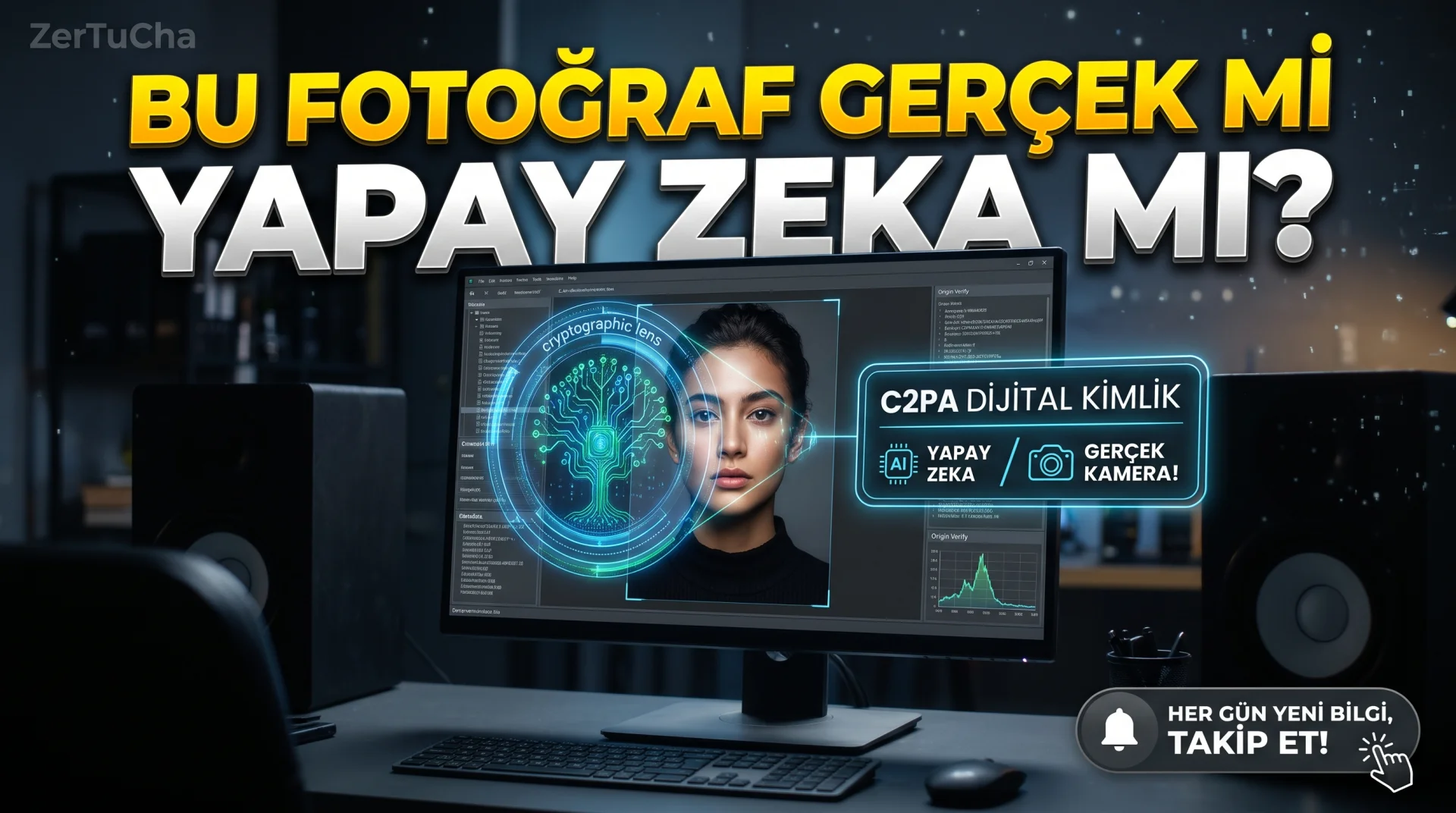
It has become impossible to distinguish with the naked eye whether a striking news photo, a celebrity's image or a product image that we encounter every day on social media was taken with a real camera or produced by artificial intelligence (AI)! Classic "AI Detection Sites" often make mistakes by calling real photos "85% Artificial Intelligence" because they make predictions only by looking at pixels. In order to solve this global trust crisis, technology and media giants such as Adobe, OpenAI, Google, Microsoft, Sony, Leica and BBC have joined forces to create digital ID cards of photos and videos C2PA (Content Credentials) standard! It is now possible to verify within seconds with a cryptographic seal whether an image was produced with which camera or which artificial intelligence tool, and whether it was later changed in Photoshop! The address and working logic of this free verification tool are right below!
Brief Summary: C2PA (Content Credentials) is a cryptographic "digital nutrition
Leave a Comment to Read the Rest of the Article
Did you find our content useful? We are curious about your thoughts on the subject.
labeling" standard that is embedded into photos and videos. contentcredentials.org/verify you can verify for free whether that image was taken with a real camera or produced by artificial intelligence.
What is C2PA and Content Credentials?
C2PA is an open global standard for documenting the origin and issuance history of digital media with a cryptographic signature. The moment an image or video is produced, an immutable ID is added to it; Thus, it is proven whether the work was created with an artificial intelligence model or a physical camera.
The difference from classical artificial intelligence detectors that make predictions is that they are based on mathematical digital signatures instead of probability calculations. OpenAI, Google, Adobe, Meta, YouTube, TikTok and new generation camera manufacturers are rapidly adopting this standard.
Classic AI Detector vs. C2PA Authentication
The reliability and operating logic differences of the two methods are listed in the table below.
| Feature | Classic AI Prediction Sites | C2PA Content Credentials |
|---|---|---|
| Operating Method | Pixel estimation (High margin of error) | Cryptographic digital signature (Exact record) |
| Edit History | Cannot display | Lists what was changed with which software |
| False Alarm Risk | High (can AI to real photo) | Near zero (Signature either exists or does not exist) |
| Supporting Giants | Independent small vehicles | Google, OpenAI, Adobe, Sony, Meta, BBC |
How to Use Content Credentials Verify?
Follow these steps to check the digital ID of a photo or video in your possession in 10 seconds:
- From your browser https://contentcredentials.org/verify (No membership or login required).
- Drag and drop the image (JPG, PNG, WebP) or video you want to check into the review area in the middle of the page.
- If the image bears the C2PA signature, the work's Manufacturer Application / Model (e.g. OpenAI, Google, Adobe Firefly or Leica/Sony Camera) is listed immediately.
- "Edits and Activity" tree to see step by step whether the image has been subsequently cropped, color adjusted, or generative AI fill added.
- In the image "No Content Credential found" warning appears, you can understand that the file was either taken with an old device or its metadata was deleted by taking a screenshot on social media.
Privacy, Restrictions and What It Means to Creators
The verification tool does not publish uploaded images to a public database. But the most important technical limit is this: The C2PA seal can be broken when a photo is screenshotted or passed through an application that deletes metadata. However, YouTube, Instagram and TikTok's reliance on C2PA to automate their "Made with AI" tags is permanently changing the standard of transparency in the world of media and digital publishing. For digital media strategies Zertucha content and technology solutions.
Frequently Asked Questions
Is a photo without a C2PA signature definitely fake or artificial intelligence?
No. Older phones, classic cameras, and messaging apps that delete metadata (e.g. WhatsApp compression) can remove the C2PA signature; Therefore, the absence of a signature alone is not evidence of forgery.
Do Instagram, TikTok and YouTube read C2PA data?
Yes. Major platforms, especially Meta (Instagram/Facebook), TikTok and YouTube, have started to automatically add "AI Information" tags to content produced with artificial intelligence by reading C2PA information.
Can I add a C2PA digital signature to images I have taken or designed?
Yes. You can add your own digital signature to your works with Adobe Photoshop, Lightroom, new generation cameras that support it, and open source C2PA command line tools.

No comments yet. Be the first to comment!
Leave a Comment